
Something significant is happening in the communications landscape, and many organisations are not yet paying close attention. People are increasingly turning to AI systems for answers instead of traditional search engines. And that shift will fundamentally change how organisations earn visibility and credibility.
A recent Gartner report titled Top Predictions to Inform 2026 Communications Strategies highlights several trends that will redefine the role of Chief Communications Officers in the coming years.
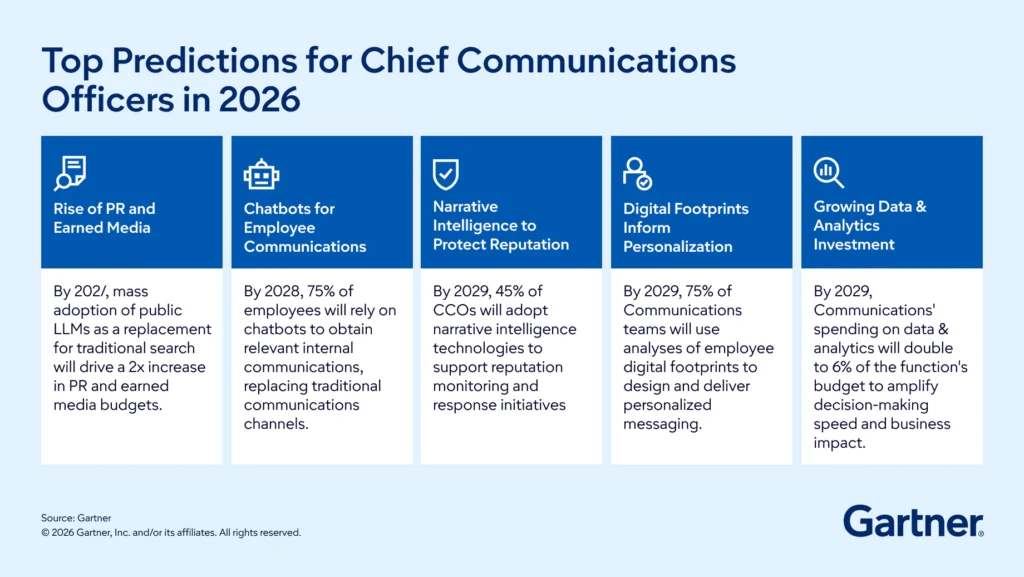
Among the predictions are:
• By 2027, mass adoption of public LLMs as a replacement for traditional search will drive a twofold increase in PR and earned media budgets.
• By 2028, 75% of employees will rely on chatbots for internal communications, replacing traditional channels.
• By 2029, 45% of CCOs will adopt narrative intelligence technologies to monitor reputation in a growing disinformation environment.
• By 2029, 75% of communications teams will analyse employee digital footprints to deliver personalised internal communication.
• By 2029, communications spending on data and analytics will double to accelerate decision-making and business impact.
You can read the full report here.
However, the prediction that caught my attention most is the first one: “By 2027, mass adoption of public LLMs as a replacement for traditional search will drive a 2x increase in PR and earned media budgets.” This insight reinforces something we have consistently emphasised at Teo-Inspiro and one of the reasons we launched the Impact Storytelling Masterclass.
For years, many organisations have focused heavily on paid visibility. Paid ads. Boosted posts. Sponsored placements. But in the AI-driven information ecosystem that is emerging, credibility will matter more than paid visibility. AI systems tend to cite earned, shared, and organic content far more than paid media. According to a vendor study referenced in the report, over 95% of links cited by AI systems are non-paid mentions, with 27% coming directly from earned media coverage.
This has important implications.
If AI tools such as ChatGPT, Claude, and Perplexity increasingly become the first-place people go for answers, then the organisations that will be referenced are those that already have credible material about their work across the internet.
That credibility is built through:
• recognised media features
• strong thought-leadership articles
• research publications
• well-documented impact stories
The traffic trends already point in this direction. AI chatbots such as ChatGPT (+608%) and Perplexity (+262%) experienced significant year-over-year growth in traffic between the first half of 2024 and the first half of 2025, while traditional search engines like Google and Bing have begun to decline, despite still holding the larger share of traffic.
For organisations that want to become authoritative voices in their sectors, the path forward is becoming clearer.
It requires investing in:
• credible storytelling
• strategic media engagement
• strong data and evidence about impact
• consistent thought leadership
One question I continue to reflect on after reading this report is this:
If AI systems increasingly determine which organisations are cited as credible sources, what evidence about your work currently exists online for those systems to reference? Many organisations are doing remarkable work. Yet very little of it is documented in ways that build long-term narrative authority; through media coverage, research publications, or credible thought leadership.
In the coming years, communications strategy may shift from visibility management to knowledge and narrative ownership. I am curious to hear from other communications and development professionals: Are organisations already adapting their PR and communications strategies for the rise of AI-driven search?
One practical shift I expect to see more organisations make is investing in institutional knowledge assets.
For example:
• periodic insight articles from organisational leaders
• research briefs or sector reports
• documented case studies of programme impact
• expert commentary in recognised media platforms
Over time, these materials form a body of credible knowledge that strengthens an organisation’s reputation and increases the likelihood that it will be referenced in emerging AI discovery systems. This is one of the reasons I continue to emphasise impact storytelling as a strategic function, not just a communications activity.
In other words, communications strategy must move beyond counting followers and social media likes. The real competitive advantage will come from owning credible narratives about your organisation’s expertise and impact. Because in an AI-driven information ecosystem, the organisations that will be cited, referenced, and trusted are those that have already done the work of building authority.